
Warning: Undefined variable $isTheFeaturedTitleInUse in /opt/homebrew/var/www/interfaithministryservices.com/blogs/index.php on line 1595
Coach Kiki
Coach Kiki
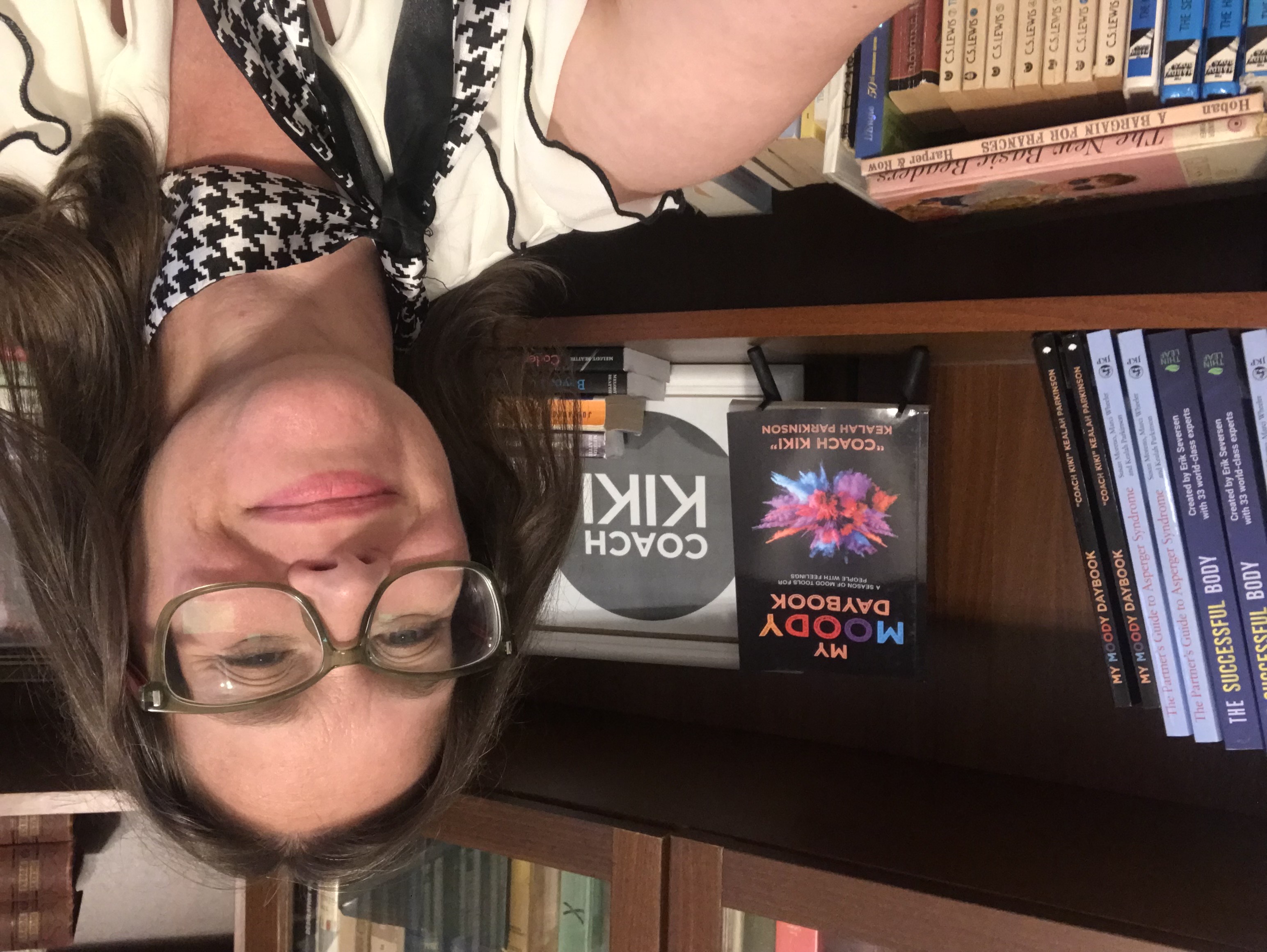
"Coach Kiki" Kealah Parkinson is the author of My Moody Daybook: A Season of Mood Tools for People with Feelings, a practical and encouraging guide to navigating emotions and building resilience. Drawing from her 30 years of experience in communications - as an author, coach and support group moderator - and her own journey of healing from a suicide attempt, addiction and bipolar disorder, Kiki offers a powerful message of hope and transformation. She combines her coaching expertise with her personal experience to give readers the practical tools they need to feel and heal. Beyond her book, Kiki hosts a community radio show and podcast, offers online resources and coaches individuals and teams, as well as families. Her insightful book offers readers a roadmap to navigate their feelings and build resilience.
Hi, I'm Coach Kiki! How are you feeling?
A lot of us know the polite social answer to this question: "I'm fine." ... But are you fine?
On social media, I'm a sort of Feelings Mom. I teach people some of the basics - like The Four Corners of Feelings (mad, glad, sad and scared) or the simple 1-Minute Mood Tool that anyone can use to learn more self-awareness to build emotional intelligence in literally a minute a day. You can learn more about this, and me, here: CoachKiki.com.
This is my story: I'm Kealah (KEY-la) Parkinson. "Coach Kiki" is easier for a lot of people to remember. But I love my name. As a shy kid, introverted and bookish, growing up in a small Midwestern town, my name was character-building. I had to speak up, in spite of my shyness, to correct strangers and authority figures when they mispronounced my name. I had to face the embarrassment of all eyes on me as I did - say, helping a substitute teacher at the head of a large classroom - when all I wanted was to stay hidden behind my favorite book in a corner like The Invisible Girl.
As I grew up, I learned to find my voice and find my confidence as first a writer, then a speech coach ... and eventually as a public speaker, myself. I'm now a global author and Communications Coach, helping others to do the same.
I also found my Key Motto™. That's the tool I teach every one of my clients in our first session. A kind of affirmation statement on steroids, it's the secret to shifting out of fight-or-flight and into more resourced thinking with simple self-talk. Some of the mottos I've helped people to find for themselves over the years include these gems:
- "I'm great at learning."
- "I can learn anything new."
- "It's okay to make a mistake."
- "I step into confidence."
- "I am what I am."
It's total self-acceptance! Doesn't that sound great?
What's my own Key Motto™? To find it, I went through the same steps I use for everyone:
- Remembering a time when I was struggling to communicate the way I wanted (I recalled my first public speech as a Communications Coach to a room full of business professionals and the local newspaper), I ran through my mental checklist to name what my BODY felt (butterflies in my belly, a racing heart, sweaty & shaky).
- I named the MOODS that I felt then, too: nervous, excited, scared and anxious.
- Finally, I voiced the THOUGHTS that always speak my own personal brand of Imposter Syndrome. For you or someone else, they may be something like, "No one ever listens to me," or "I'll never be as good as my brother," or simply, "Mistakes are dangerous," all based on past conditioning or misinterpreted messages that we learn growing up. Mine are simply, "I am the invisible girl."
These 3 Steps (what I call The BMT Index™) help us to identify the working parts of fight-or-flight—the triggers in our BODY, MOODS & THOUGHTS that are activated when someone pushes our "shame button."
Shame gets a bad rap in society. And, no, it isn't great. But it's been a handy tool we've used for rapid social learning on a large scale: Someone's doing something dangerous? Shame them in front of the whole community and you're likely to not just stop that behavior in the moment, but also teach everyone who's watching that they don't want to make the same mistake. Each person on the planet has what I call a "shame button." We need it to keep us in line in our worst moments to keep our communities safe for each other. ... But pushing each other's buttons at will has created more negative consequences than we've realized - like those internal thoughts that say, "I'm bad, wrong or unlovable," when we make a mistake or act in a way others have shamed us for in the past that weren't really harmful to the world.
Knowing what triggers our shame button - for me, "I am the invisible girl" - helps us to come to the final step in finding our personal Key Motto™. That step is coming to accept that, in spite of our shame, we also have evidence of personal success.
Some of my hundreds of Communications Coaching clients over the last 17 years have been able to remember that, in spite of, say, their ADHD that meant lower grades through school, they've mastered hobby subjects and tons of info for job positions. The "shame button" negative thought, "I'm just not smart," then translates to a Key Motto™ of "I'm great at learning." When they accept that, yes, their perfectionistic father expected them to be perfect - and they were not perfect - but they've also slowly stretched into leadership positions throughout most of their lives, they shift the thought, "I have to be perfect now!" to "I can learn anything new."
You see the pattern?
In my own journey to self-acceptance, I let so many other people push my shame button, that I started doing it, myself, even when no one was around. My mental health slid into depression; I self-medicated with drugs and alcohol; I felt and acted completely unworthy of being a loved, loving and lovable member of society. Hiding in the corners of my own life, I lived like I was nothing more than an invisible girl. And yet: I also had evidence that I had been trusted with leadership positions; was a good friend and confidante; was someone that people turned to when they needed loving support and help.
The THOUGHTS I discovered in Step 3 of The BMT Index™ on the day that I delivered my big breakout presentation were: "I'm too short, too high-voiced and have no stage presence; therefore, no one will listen to what I have to say." Accepting these as beliefs I held, I shifted into a much more empowering thought to embrace all of the evidence, good and bad. My Key Motto™ is: "I am petite and powerful!"
If you're ready to find your own power, let's connect. Here are some easy next steps:
- Hear some of my conversations (like this one with Rev. Rhonda Schienle) at my podcast/local community radio show, Tune In: Radio for Your Mind, Body & Soul
- Learn more about your own human feelings with the daily devotional, My Moody Daybook
- Join Brainvary Hub, the online safe space community that I co-host with Amy Lakeberg for neurospicy people and the people who love them
- Check out my Skool communities - Confident Communicators Club (where professionals go to reach the peak of presentation) or Confident Communicators Clinic ... for elite pros ready to seriously upskill speaking
I'm here to meet you where you are and help you to speak your truth - with confidence - so that you really can be fine.